Start a Project
Case Study

Wix storefront. Clover payments. One clean operating model.

Project 501 connected an existing Wix storefront to Clover payment processing without forcing a platform migration. The result was a production-ready workflow built around clear ownership, transaction visibility, and supportability.

Platform

Wix + Clover

Focus

Payment integration

Build

Custom backend workflow

Priority

Operational clarity

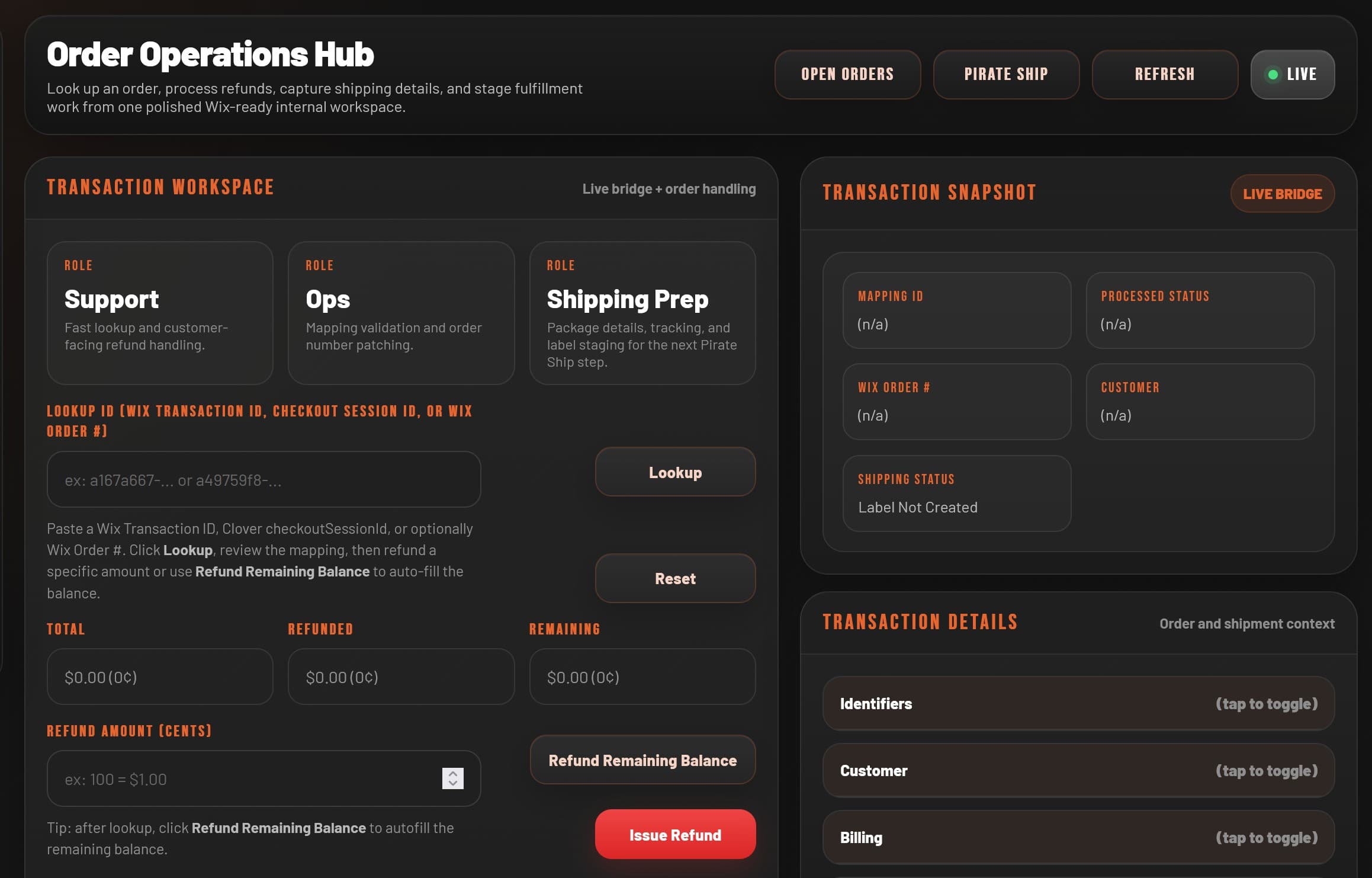
Project 501 dashboard overview

System ownership

Wix owns commerce and inventory. Clover handles payments and reporting.

That separation shaped the implementation and reduced conflict between storefront logic, payment events, and downstream operations.

The Problem

Keep the storefront. Change the payment layer.

The client needed to preserve an existing Wix storefront while moving payment processing to Clover. That sounds straightforward until transaction correlation, hosted checkout redirects, webhook confirmation, refunds, and support visibility all have to work together.

Architecture

Wix storefront remained the source of truth for commerce, cart flow, and inventory.

Architecture

Clover handled payment processing and downstream reporting.

Architecture

Custom backend logic connected checkout state, webhooks, settlement events, and refunds.

What Was Built

Production-focused integration pieces, not just a checkout handoff.

The work centered on the parts that make a payment flow usable in production: state management, event handling, support tooling, and enough transaction context to make refunds and troubleshooting practical.

01

Custom payment flow

A Hosted Checkout flow let customers begin checkout in Wix, complete payment in Clover, and return through the expected success or failure paths.

The payment path had to feel predictable to the customer while still preserving the platform boundaries behind the scenes.
02

Transaction mapping layer

A dedicated mapping layer tracked the relationship between Wix transactions, Clover checkout sessions, Clover payments, and refund activity.

That mapping layer made it possible to trace state cleanly across systems when support or reconciliation questions came up.
03

Webhook settlement handling

The backend processed Clover webhook events, validated requests, prevented duplicate processing, and submitted the correct settlement signals back into Wix.

Reliable event handling mattered because settlement and platform state had to stay aligned after the customer finished checkout.
04

Refund support

Refund operations were built around Clover payment and order relationships, with validation and remaining-balance checks tied to internal transaction lookup.

The refund flow needed to support real operational use, not just the happy path for one-off transaction reversals.
05

Operational visibility

Structured observability and admin support patterns made failed transactions, refund issues, and mapping problems easier to trace.

That visibility reduced the support burden by making unusual states easier to inspect before they turned into guesswork.
Key Challenges Solved
  • Preserving the existing storefront instead of forcing a platform migration.
  • Correcting early assumptions about authentication, endpoint behavior, and production scope.
  • Separating platform ownership so inventory, payments, and reporting did not conflict.
  • Making refunds, failure tracing, and transaction support practical for day-to-day operations.
The Outcome
  • Keep the existing Wix storefront
  • Process payments through Clover
  • Maintain transaction visibility across systems
  • Support refunds with more confidence
  • Reduce operational confusion around inventory ownership
  • Improve maintainability through better logging and transaction mapping
Why It Matters

Project 501 shows the difference between a basic integration and a production-ready commerce workflow. The value was not only in connecting Wix and Clover, but in shaping a durable system around ownership, reliability, and practical support.

Need Something Similar?

Some integrations need more than a plugin install.

If your business needs to connect platforms that were never really designed to work together cleanly, we can help evaluate the workflow and define the right operating model before implementation starts.