
Diagnose the failures behind unstable checkout and payment operations.
When payment systems break, the issue is rarely isolated to one button or one endpoint. Failures usually happen across authentication, API communication, webhooks, transaction state, refund handling, settlement logic, or the way multiple platforms interact.
We help diagnose and repair those failures so the payment workflow becomes more reliable, traceable, and easier to support.
Investigation and repair across the payment path, not just one surface symptom.
The work usually starts by locating the real failure boundary, then tracing how processor behavior, platform logic, internal state, and operational visibility interact around it.
- Checkout failure diagnosis
- Processor API troubleshooting
- Webhook debugging
- Refund flow investigation
- Reconciliation and settlement troubleshooting
- Payment system root-cause analysis
Failure points tend to cluster around a few operational boundaries.
Checkout handoff
The storefront or application sends the customer into the payment flow, but the handoff is incomplete, inconsistent, or missing critical transaction context.
Diagnostic pattern
This usually signals a systems boundary problem, where the visible failure is only one part of a broader breakdown in transaction flow.
Auth and configuration issues
Keys, credentials, account configuration, environment mismatches, or processor settings prevent requests from behaving reliably in production.
Diagnostic pattern
These issues often look small at first, but they create outsized instability because they undermine trust in the entire payment path.
Webhook handling
Events do not arrive, are rejected, are handled out of order, or create incorrect system state after a successful processor action.
Diagnostic pattern
Webhook failures are rarely isolated; they usually expose broader weaknesses in state handling, observability, and cross-system coordination.
Refund logic
Refund requests succeed in one layer but fail in another, or they create broken support workflows because status, timing, and system state do not stay aligned.
Diagnostic pattern
Refund problems are operationally expensive because they affect both customer trust and the internal support process at the same time.
Reconciliation and state mismatches
Reporting, settlement data, internal dashboards, and transaction records stop telling the same story, making support and operations unreliable.
Diagnostic pattern
This is where debugging has to account for business impact, not just technical correctness, because inconsistent records break day-to-day confidence.
The kinds of signals that usually trigger this work.
This service usually starts when payment failures are recurring, the revenue risk is obvious, and nobody is confident about the true failure boundary.
- Checkout failures are costing revenue
- The payment processor integration is unstable
- Webhook events are not arriving or not being handled correctly
- Refunds fail or create inconsistent state
- Reporting and transaction status do not line up across systems
- Nobody is quite sure where the failure is actually happening
Tracing the failure path, then repairing the weak points underneath it.
The actual implementation work usually combines diagnosis, root-cause isolation, repair, and supportability improvements across several layers of the system.
- Failure tracing across systems
- Authentication issue diagnosis
- Processor request and response debugging
- Webhook signature and event handling review
- Refund workflow analysis
- Settlement and reconciliation investigation
- Operational logging and supportability improvements
Strongest fit when the system exists, but confidence in it does not.
This is a strong match when payment infrastructure is already in place, but recurring issues make it difficult for the business to trust its behavior.
- Already have payment infrastructure in place but cannot trust it
- Are dealing with recurring transaction issues
- Need senior-level diagnosis rather than surface-level patching
- Want a clearer operational understanding of how the payment workflow behaves
Common environments around payment failure diagnosis.
These are the platforms and surfaces that commonly shape this kind of debugging and repair work.
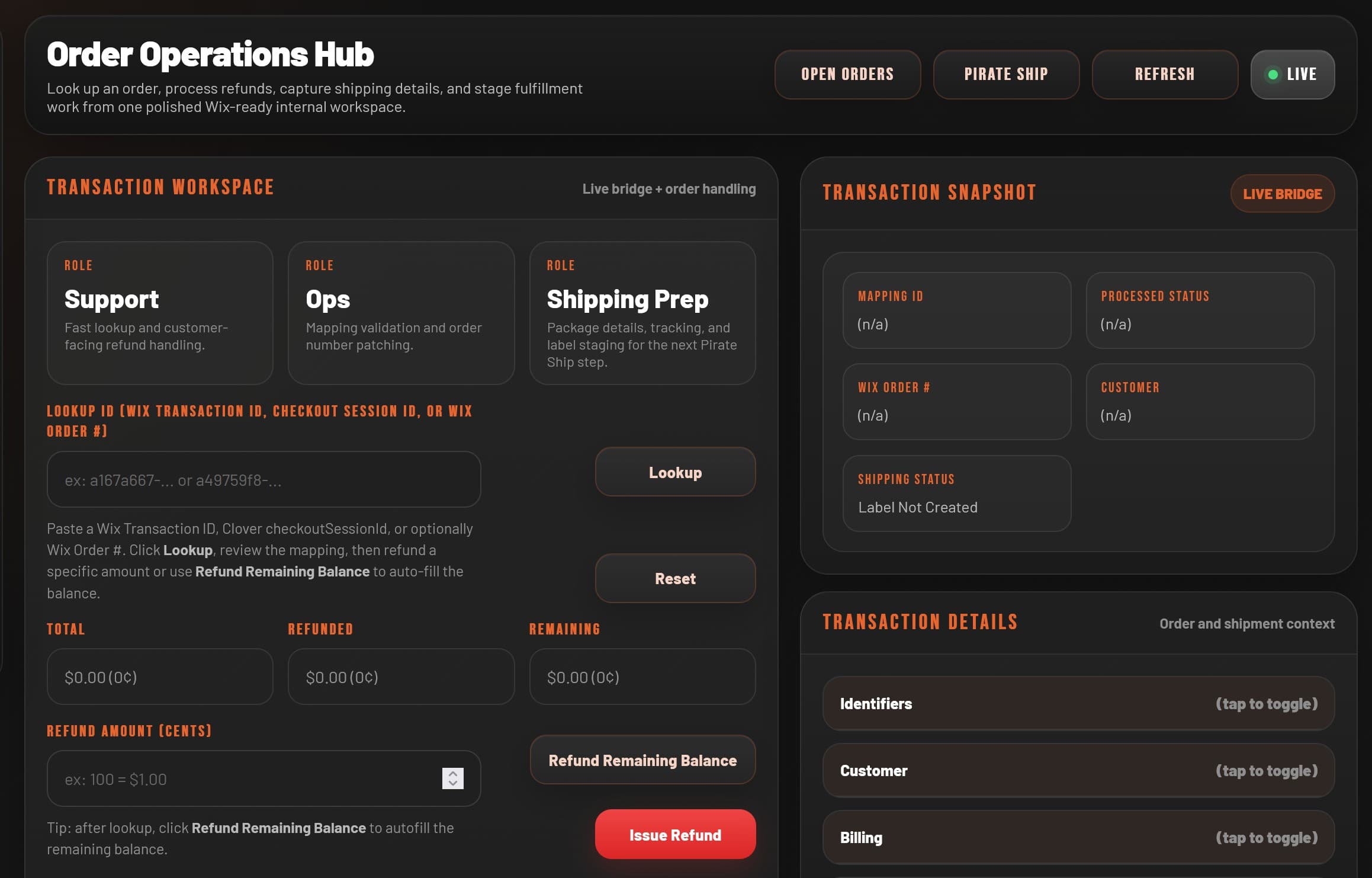
Project 501
Custom Wix + Clover Payment Integration
A custom Wix + Clover implementation that required careful architecture, transaction mapping, webhook settlement handling, refund support, and support-oriented observability.
It is a strong example of the kind of system where debugging, repair, and operational visibility have to work together.
Diagnose the root cause, then repair the system underneath.
If checkout failures, processor issues, refund problems, or webhook bugs are creating risk for the business, we can help trace the failure path and repair the system underneath.
Need to talk through the fit first? Contact us and we can help define the right next step.